Output
77% of fans felt overwhelmed. Rebuilt the information architecture around match state: +27% user engagement.
Role
Design Lead
Deliverables
Product Dev | Website | Visual Branding
Timeline
2022




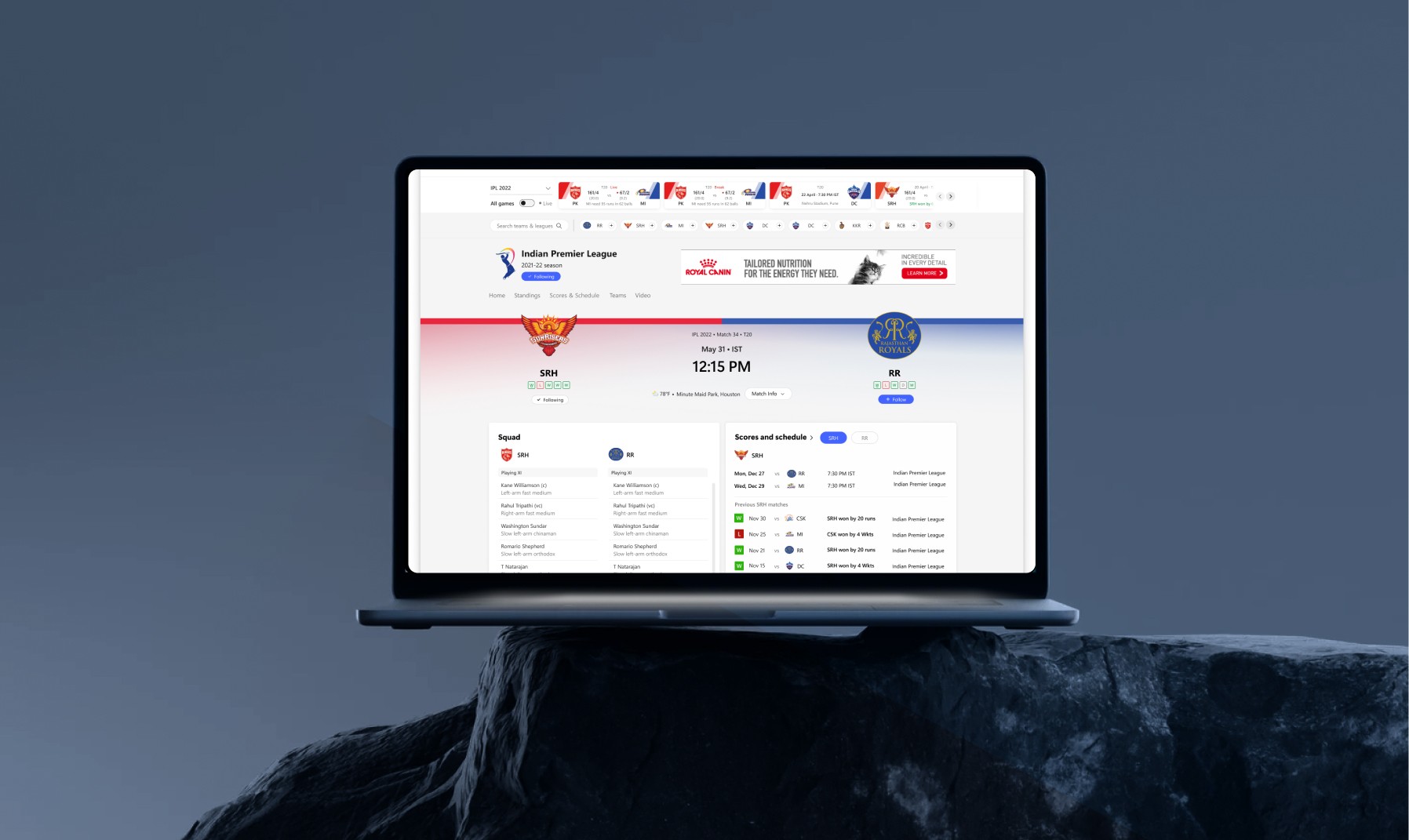
MSN Sports
Re-imagining the MSN Sports experience
When I worked on MSN Sports at Microsoft, the challenge wasn’t a lack of sports content. MSN already had a large audience and access to a wide range of sports information. The bigger problem was how that information was organized and consumed.
The existing experience made it difficult for users to quickly find what mattered to them, particularly during a live match. My focus was to rethink the experience around the way sports fans actually follow a game, with cricket as the primary use case.
5.54M Daily Active Users
171 Quantitative research participants
10 Qualitative research participants
67% used a second screen while watching cricket
77% felt overwhelmed by MSN sports pages
5.2% used Bing/MSN to stay updated with cricket
The problem
MSN Sports had plenty of content, but users were often forced to process too much information at once.
Research showed that 77% of users felt overwhelmed by MSN sports pages. At the same time, 67% used another app or website while watching cricket to access information such as detailed scorecards, statistics, and insights.
This pointed to a larger problem: users weren’t necessarily looking for more content. They needed the information they cared about to be easier to find and understand.
The opportunity was to make MSN Sports more useful throughout the entire sports journey, from discovering a match to following it live and catching up afterward.
Research showed a second-screen problem
I led research with a global audience of casual and hardcore sports fans between 18 and 60 years old.
We used:
171 quantitative survey participants
10 qualitative participants
Questions around sports consumption, match behavior, preferred platforms, and information needs
Competitive benchmarking across major sports platforms
One finding stood out.
Users were changing where they got information depending on what was happening in the match.
Before a game, they wanted teams, players, venue information and predictions.
During the game, they wanted the score, commentary and match statistics.
After the game, they wanted results, highlights, player performance and analysis.
The experience needed to reflect that change.
Competitive research
I benchmarked MSN against platforms including ESPN, Yahoo Sports, CBS Sports and NBC Sports.
Each product had strengths that users had become familiar with:
ESPN had strong commentary, analysis and video.
Yahoo Sports focused heavily on personalization and followed teams.
CBS Sports had strong video and fantasy experiences.
Other platforms surfaced scores, league information and news prominently.
This also introduced an important constraint.
Sports fans already had expectations about where familiar information should appear. A new experience couldn’t simply rearrange everything for the sake of being different.
The design needed to preserve familiar patterns while improving how information was prioritized.
From feature lists to priorities
We mapped the opportunities against user value and feasibility to determine what should make it into the first phase.
The initial focus was on improving the core sports experience:
Better navigation and content discovery
Latest and trending news
Follow teams
Personalization
Match highlights
League coverage
In-depth commentary
Polls and quizzes
Pre-game, live-game and post-game experiences
Longer-term opportunities included predictions, social features, gamification, third-party partnerships and AI-generated content.
This helped keep the first release focused on solving the core experience rather than trying to match every competitor feature.
Situational information architecture
The biggest shift in the design came from looking at information through the context of a match.
Users don’t give every piece of information the same attention. What matters changes depending on whether the match is about to start, currently being played, or has finished.
I structured the information architecture around three states:
Pre-game
The experience prioritizes:
Team squads
Match details
Players
Venue and weather
Recent news
Fantasy information
Live game
The hierarchy changes to prioritize:
Score
Commentary
Match events
Player performance
Statistics
Live updates
Post-game
The focus shifts toward:
Final score
Player of the match
Highlights
Match summary
Commentary
Post-match news
Fantasy results
Instead of designing one static page, we designed an experience that changed with the user’s context.
The dynamic card system
This thinking led to a time-based dynamic card system.
Rather than giving every module the same priority, cards could move up or down the hierarchy based on the state of the match.
A scorecard might become the dominant element during a live game. After the match, highlights and player performance could take its place.
This gave us a simple principle for the experience:
The most relevant information should get the most attention.
It also created a scalable framework for handling the large amount of content available across MSN Sports.
The redesigned sports experience
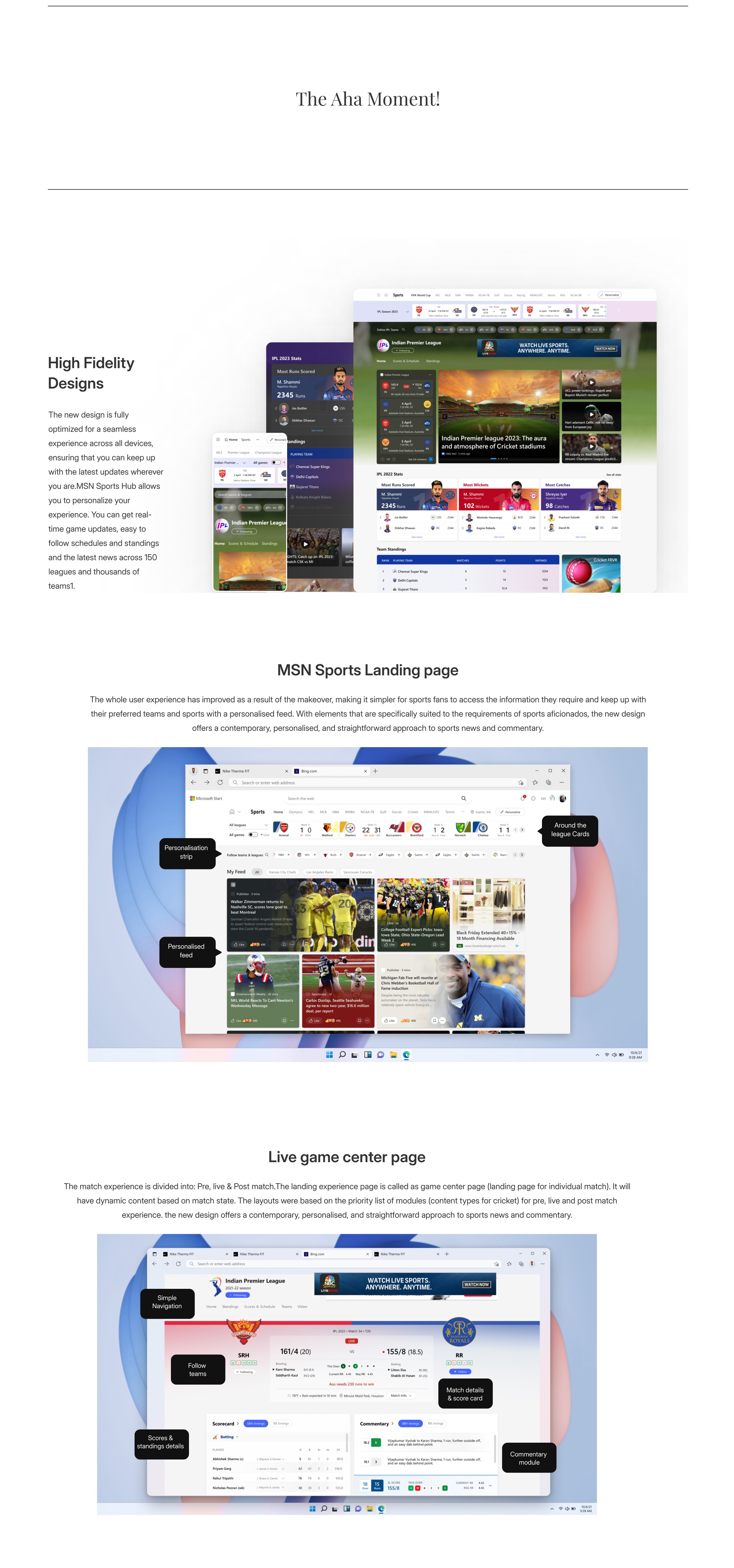
The final direction brought the different pieces together into a more personalized sports hub.
The MSN Sports landing page introduced:
Personalized feeds
Followed teams
League information
News
Highlights
Scores
Content across sports
The Game Center then provided a dedicated match experience, with the information hierarchy adapting across pre-game, live-game and post-game states.
The result was a sports experience designed around how people actually follow a game rather than treating every piece of content as equally important.
My role
As the Lead Designer, I led the design process with one junior designer.
My responsibilities included:
Defining the experience direction
Leading user research
Synthesizing research findings
Competitive benchmarking
Information architecture
Feature prioritization
Interaction and visual design
Stakeholder collaboration
Translating the strategy into the final experience
The project required balancing user expectations, content complexity, personalization, and the constraints of an existing high-traffic platform.
The outcome
The work established a new direction for MSN Sports around contextual information, personalization and match-state-based content hierarchy. After launch, user engagement rose 27%.
The strongest outcome of the project was the shift in thinking from:
“How do we fit more sports content onto the page?”
to:
“What does a sports fan need right now?”
That question became the basis for the information architecture, feature prioritization and dynamic card system.
Thankyou
